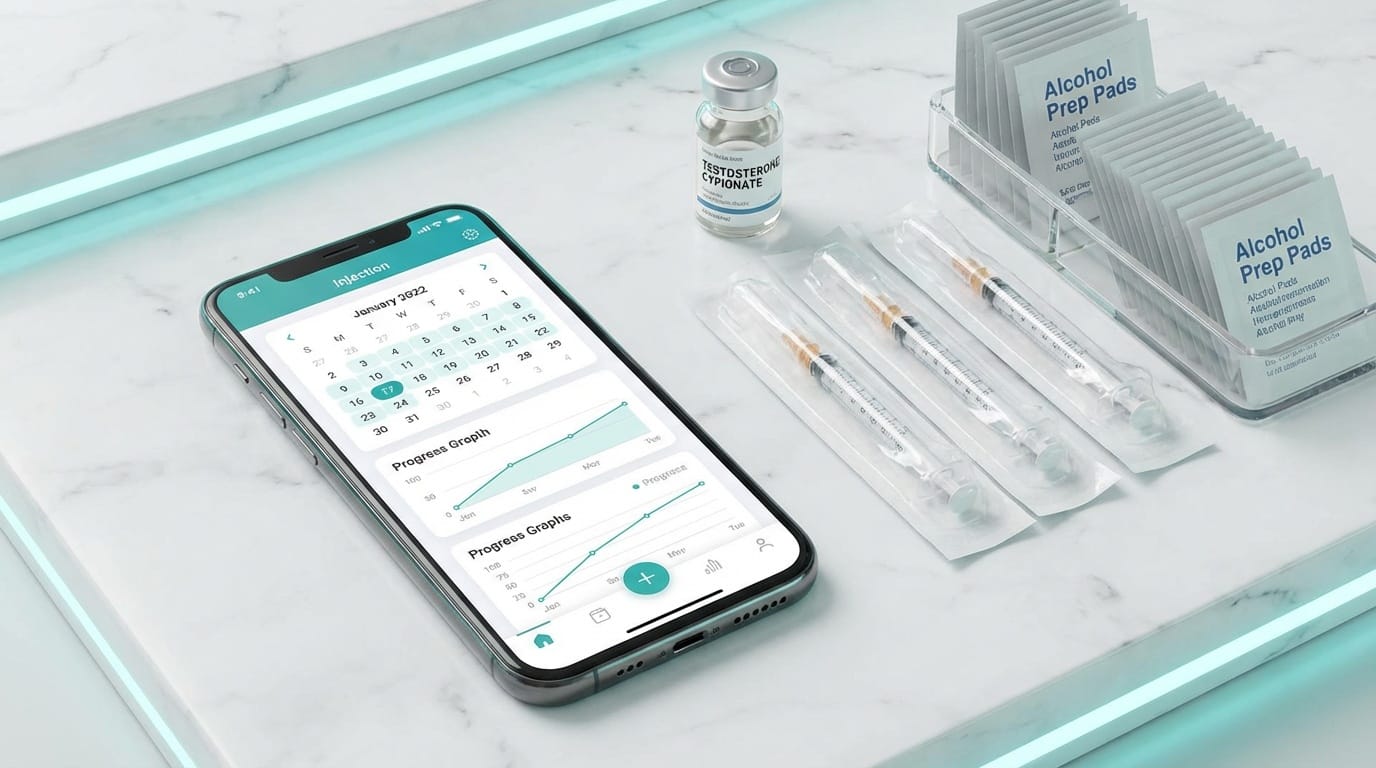
TRT Injection Tracker: How to Never Miss a Shot or a Symptom Again
Testosterone replacement therapy can be life-changing, yet around 70.0% of patients say they are satisfied or find TRT effective, which means a large minority still struggle with dosing, timing, and side effects that better tracking could help prevent. A dedicated TRT injection tracker gives us a simple way to log injections, symptoms, labs, and medications so treatment becomes data-driven instead of guesswork. In this guide, we explain how to build and use a practical tracking system that fits real life, whether you are on weekly injections, auto-injectors, or long-acting formulations.
Key Takeaways
| Question | Key Answer |
|---|---|
| What is a TRT injection tracker? | A structured way (app, spreadsheet, or notebook) to record injection dates, doses, sites, symptoms, and lab results so you and your clinician can adjust TRT based on real data. |
| Why should I track my TRT injections? | Tracking improves adherence, helps correlate symptoms with timing and dose, and creates a clear timeline you can share during appointments. We discuss this in detail on our about page. |
| How often should I log data? | Log immediately after each injection and add short daily notes on mood, energy, libido, and sleep. This gives enough data without becoming overwhelming. |
| Can an injection tracker improve satisfaction with TRT? | Patients on injection-based TRT already report strong satisfaction; a tracker helps fine-tune protocols, which may further support that satisfaction over time. |
| What should I include in my tracker? | Injection date/time, dose, compound, route, site, side effects, medications, blood pressure, and key lab results are the core fields we recommend. |
| Is privacy important when tracking TRT? | Yes. Use secure tools and understand their data policies; our privacy notice explains how we think about data protection. |
| Where can I learn more about TRT and tracking? | We regularly publish hormone-health content on our blog, including updates from our author Moe on TRT optimization. |
1. What a TRT Injection Tracker Is (and Why It Matters)
A TRT injection tracker is any structured system you use to log testosterone injections and related health data over time. It can be a dedicated app, a spreadsheet, or even a paper chart, as long as it is consistent and detailed enough to guide decisions.
We design tracking frameworks around the way TRT is actually prescribed: scheduled injections, periodic lab work, and symptom check-ins. When those three streams of data live in one place, we can see patterns that are easy to miss in day-to-day life.
2. Core Features Every TRT Injection Tracker Should Include
We recommend building your tracker around a clear set of mandatory fields. This keeps entries quick but still clinically useful, even months or years later.
Essential data fields
- Date and time of injection – to calculate intervals and spot peaks/troughs.
- Dose and concentration – for example, 120 mg testosterone cypionate (200 mg/mL).
- Route and site – intramuscular vs subcutaneous, and where you injected.
- Symptoms – short notes on mood, libido, energy, sleep, and irritability.
- Vitals and labs – blood pressure readings and key lab results when available.
Adding a simple 1–10 scale for each symptom turns subjective feelings into trendable data. Over time, you can overlay dose changes and symptom scores to see what actually works for you.
3. Why Tracking Injections Improves TRT Adherence and Satisfaction
Injection-based TRT often performs well in satisfaction studies, but missed doses and inconsistent schedules can quickly erode those benefits. When everything is logged, you no longer rely on memory to know when your last injection was, which helps you stay on protocol.
We also see that trackers reduce anxiety. Instead of wondering if what you feel is “normal,” you can look back at similar points in previous cycles and see whether the pattern repeats. That context makes dose adjustments more grounded for you and your clinician.
Real-world benefits of an injection tracker
- Fewer missed or delayed injections.
- Clear context for mood or libido dips.
- Better preparation for lab work and follow-up visits.
- A written history that can follow you if you change clinics.
4. Designing Your Own TRT Injection Tracker Template
We like to start with a simple table that you can use in a spreadsheet, notebook, or app. The columns stay the same; you just add one row per injection and occasional rows for lab work or key events.
| Date & Time | Dose & Compound | Route & Site | Mood (1–10) | Libido (1–10) | Energy (1–10) | Notes (side effects, events) |
|---|---|---|---|---|---|---|
| 2026-01-05 08:00 | 120 mg Test C (200 mg/mL) | SubQ – Right thigh | 7 | 8 | 7 | Slept 6 hours; mild injection-site soreness. |
For labs, you can add a second table that logs total testosterone, free testosterone, hematocrit, estradiol, SHBG, and blood pressure. Over time, your tracker becomes a compact timeline of everything meaningful in your TRT journey.
5. Daily Symptom Tracking: Beyond Just Injection Dates
A strong TRT injection tracker does more than mark when you used a needle. Daily or near-daily symptom entries show how you feel between injections, when testosterone levels can fluctuate the most.
We suggest picking a small set of metrics and sticking with them:
- Mood – general emotional state, anxiety, or irritability.
- Sex drive – desire and performance, tracked simply on a 1–10 scale.
- Energy and focus – work productivity or fatigue levels.
- Sleep quality – hours slept and perceived restfulness.
Even 10–20 seconds of daily logging can reveal patterns, such as predictable dips before your next injection or specific side effects tied to dose changes.
6. Tracking Labs, Blood Pressure, and Safety Signals
Modern safety data for TRT is more reassuring than many headlines suggest, but tracking remains essential. In early 2025, regulators confirmed no increased risk of major cardiovascular events in a large trial yet added new warnings about increased blood pressure for some products.
Your injection tracker is a natural home for this safety data. We recommend adding columns or a separate section for:
- Blood pressure – especially on injection days and a few days afterward.
- Hematocrit and hemoglobin – to monitor thickened blood risk.
- Estradiol (E2) – especially if you notice fluid retention or mood swings.
- Cholesterol profile – periodic checks to monitor long-term effects.
With this information alongside your injection log, you and your clinician can make earlier, more precise adjustments instead of waiting for problems to become obvious.
7. Choosing the Right Tool: App, Spreadsheet, or Paper Log
There is no single “best” TRT injection tracker; the right choice is the one you will actually use. Some patients prefer the flexibility of a spreadsheet, while others like the simplicity of a dedicated app or the tangibility of a paper journal.
Comparison of tracker formats
| Format | Pros | Cons |
|---|---|---|
| Mobile app | Reminders, graphs, easy data entry, cloud backup. | Depends on developer privacy and long-term support. |
| Spreadsheet | Highly customizable, easy to export and share, free or low-cost. | Requires some setup; graphs may be manual. |
| Paper log | No tech required, very private, easy to carry. | Harder to analyze trends; can be lost or damaged. |
We often recommend starting in a spreadsheet, then moving to an app once you know exactly what you want to track and which features matter to you.
8. Using Your Injection Tracker with Your Clinician
A TRT injection tracker becomes far more powerful when your clinician can see and interpret your data. Instead of explaining how you felt “a few weeks ago,” you can share a concise timeline with exact dates, scores, and notes.
Before each appointment, we suggest exporting or printing your last 3–6 months of entries. Highlight any periods with strong mood changes, libido swings, or side effects, and mark when doses or injection intervals changed.
Questions your tracker helps answer
- Do you feel worse just before injections or shortly after?
- Did a dose increase really improve symptoms, or did it add side effects?
- Are blood pressure or hematocrit changes linked to specific dose levels?
With clear data, the conversation shifts from guesswork to targeted problem-solving.
9. Long-Term Patterns Your TRT Injection Tracker Can Reveal
Over months and years, your TRT injection tracker turns into a longitudinal dataset that can reveal patterns you would never notice otherwise. For example, some patients find libido scores peak at specific points in the injection cycle, while others see mood changes when life stress spikes, not just when testosterone shifts.
By reviewing your tracker every few months, you can ask higher-level questions:
- Do smaller, more frequent injections feel smoother than larger, less frequent ones?
- Have side effects clustered around dose changes, medication additions, or lifestyle shifts?
- Does sleep quality predict how well you respond to your current regimen?
Seeing these patterns clearly makes it easier to decide whether you should adjust timing, dose, or even formulation with your clinician’s guidance.
10. Privacy, Data Security, and Owning Your TRT Data
Because TRT touches intimate parts of your health and life, privacy matters. When we talk about a TRT injection tracker, we also talk about who can see that data, how it is stored, and how long it will be accessible.
If you use an app, read its privacy policy carefully and consider whether you are comfortable with how your data is used. If you use spreadsheets, store them in encrypted locations when possible. Paper logs should be kept somewhere private, just as you would any medical record.
Your TRT data is part of your health story. Treat it like a medical record: accurate, organized, and protected.
Whatever format you choose, the goal is the same: you remain in control of your information, while still making it easy to share relevant parts with clinicians when needed.
Track Your TRT Protocol
Stop guessing. Start tracking. Your TRT protocol deserves better than spreadsheets.
Download HimculesRelated Reading:
Conclusion
A well-built TRT injection tracker is not a gadget; it is a simple system that turns your daily experience into clear, actionable information. By logging injection dates, doses, symptoms, labs, and safety markers, you give yourself and your clinician the visibility needed to fine-tune therapy over time.
Whether you choose an app, a spreadsheet, or a paper journal, consistency matters more than complexity. Start small with core fields, review your data regularly, and let the patterns you uncover guide thoughtful adjustments to your protocol. In our view, tracking is one of the most practical steps any TRT patient can take to move from uncertainty toward confident, informed self-management.