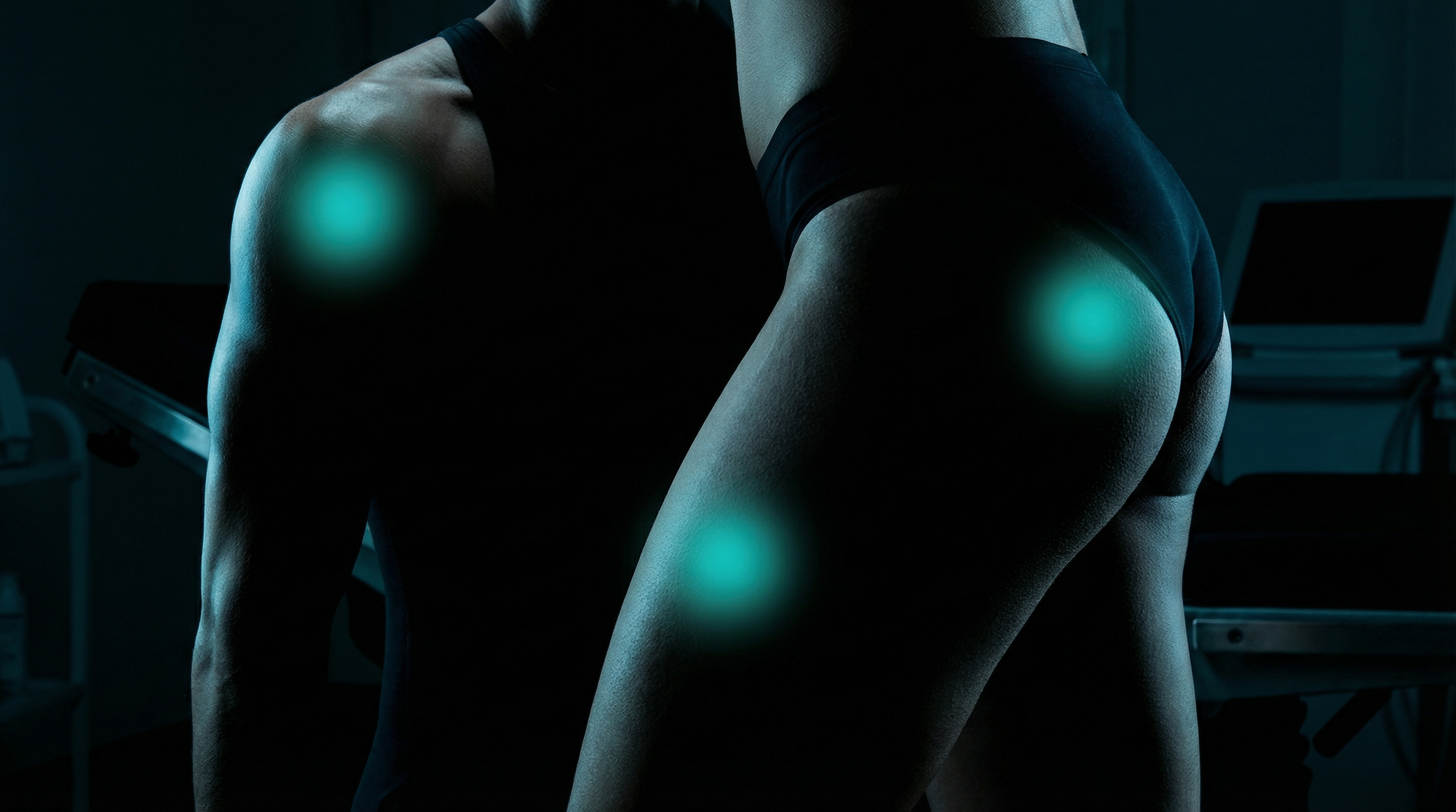
TRT Injection Sites: The Complete Rotation Guide (Deltoid, Quad & Glute)
If you're learning how to pin testosterone, choosing the right injection site is only half the battle. The other half is rotating between sites consistently so your body stays comfortable and your absorption stays dialed in. Whether you're pinning testosterone cypionate or enanthate, this guide covers every testosterone cypionate injection site you need to know — deltoid, quad, and glute — with step-by-step technique for each.
Himcules is a personal tracking tool, not a medical device. Nothing in this article constitutes medical advice. Always follow your prescribing doctor's instructions for your specific protocol.
Why Injection Site Rotation Matters
Pinning the same spot every time is one of the most common mistakes on TRT — and you won't notice the damage until months in. Here's what happens:
- Scar tissue buildup. Repeated injections in the same spot create fibrous tissue under the skin. Over time, the area hardens, and injections become more painful and less effective.
- Inconsistent absorption. Scar tissue doesn't absorb testosterone the same way healthy tissue does. You might notice your levels feeling off even though your dose hasn't changed.
- More post-injection pain (PIP). A site that's been overused gets inflamed more easily. What used to be painless starts leaving you sore for days.
- Lumps and nodules. Especially common with SubQ injections. Oil deposits can pool in overworked tissue and take weeks to resolve.
Rotation isn't complicated. It just requires a system — and sticking to it.
The 3 Main TRT Injection Sites
Most TRT protocols use some combination of these three sites:
| Site | Type | Difficulty | Best For |
|---|---|---|---|
| Deltoid (Shoulder) | SubQ or IM | Easy | Smaller volumes (< 0.5 mL), frequent protocols |
| Quad (Thigh) | SubQ or IM | Easy | Self-administration, any volume |
| Glute (Hip/Buttock) | IM | Moderate | Larger volumes (0.5–1.0 mL) |
Remember: left and right count as separate sites. So three muscle groups give you six total rotation points — more than enough for even EOD protocols.
Deltoid (Shoulder) Injection — How to Do It
The deltoid testosterone injection is a favorite for guys on frequent, low-volume protocols like E3.5D or EOD. The muscle is easy to access, and you can see exactly what you're doing.
Finding the spot
Your deltoid sits on the outside of your upper arm, roughly two finger-widths below the bony point at the top of your shoulder (the acromion). You're aiming for the thickest part of the muscle — not too high, not too far down the arm.
SubQ technique (deltoid)
- Clean the site with an alcohol swab and let it dry.
- Pinch a fold of skin and fat on the outer deltoid.
- Insert the needle at a 45-degree angle into the pinched skin.
- Inject slowly and steadily.
- Release the pinch, withdraw the needle, and apply light pressure with a cotton ball.
IM technique (deltoid)
- Clean the site with an alcohol swab and let it dry.
- With the skin pulled taut (not pinched), insert the needle at a 90-degree angle straight into the muscle.
- Inject at a steady pace — no need to rush.
- Withdraw smoothly and apply light pressure.
Deltoid tips
- Best for volumes under 0.5 mL. Larger volumes can cause more PIP in this smaller muscle.
- A 27–30g needle works great here for both SubQ and shallow IM.
- Alternate left and right delts — that's two sites right there.
If you're new to self-injection, the complete injection technique guide covers preparation, needle selection, and aftercare in more detail.
Quad (Thigh) Injection — How to Do It
Learning how to inject testosterone in thigh is usually where most guys start. It's the easiest site to reach, you can see everything clearly, and the vastus lateralis is a large enough muscle to handle any reasonable TRT volume.
Finding the spot
The vastus lateralis is the outer part of your thigh. To find it:
- Sit down and place your hand on the top of your thigh.
- Divide your thigh into thirds — top to knee.
- The injection zone is the outer middle third of your thigh.
Avoid the inner thigh and the area directly on top of the quad (rectus femoris) — the outer sweep is where you want to be.
SubQ technique (thigh)
- Clean with an alcohol swab.
- Pinch a fold of skin and fat on the outer thigh.
- Insert the needle at a 45-degree angle.
- Inject slowly, release the pinch, and withdraw.
- Apply light pressure — don't massage the area.
IM technique (thigh)
- Clean with an alcohol swab.
- Stretch the skin taut with your non-dominant hand.
- Insert the needle at a 90-degree angle into the outer middle third.
- Inject at a steady pace.
- Withdraw and apply pressure.
Quad tips
- The thigh has plenty of real estate. You can even vary your spot slightly within the outer middle third to further distribute injections.
- Some guys experience more PIP in quads than other sites. If that's you, try warming the oil beforehand or injecting more slowly.
- Quad SubQ works well if you have enough subcutaneous tissue in the area.
- Left quad + right quad = two more rotation sites.
Glute Injection — How to Do It
The glute is the classic TRT injection site, and for good reason — it's a large muscle that handles volume well. The tradeoff is that it's harder to self-administer since you can't see it as easily.
If you're learning how to give a testosterone shot in the glute, the most important thing to know is: there are two spots, and one is significantly better than the other.
Ventrogluteal vs. dorsogluteal
- Ventrogluteal (VG) — the upper-outer hip area. This is the preferred site in modern injection protocols. Less risk of hitting the sciatic nerve, less subcutaneous fat to navigate, and easier to locate with the right technique.
- Dorsogluteal (DG) — the traditional "upper outer quadrant of the butt." Still used, but carries more risk of nerve contact. Most current clinical guidance has moved away from this site.
Go ventrogluteal. It's safer and most experienced TRT guys prefer it once they learn it.
Finding the ventrogluteal site
- Place the heel of your palm on the greater trochanter (the bony knob on the side of your hip).
- Point your index finger toward your hip bone (iliac crest) and spread your middle finger toward your back.
- The injection site is in the V-shaped triangle between your two fingers.
IM technique (ventrogluteal)
- Clean the site with an alcohol swab.
- Stretch the skin taut using the Z-track method — pull the skin to one side before inserting the needle.
- Insert at a 90-degree angle into the center of the triangle.
- Inject slowly and steadily.
- Withdraw the needle, then release the skin. The Z-track helps seal the injection path and reduces leakage.
Glute tips
- The VG site is primarily used for IM injections. SubQ in this area is less common.
- A 1-inch needle is usually sufficient for VG, even at higher body fat percentages.
- Standing with your weight shifted to the opposite leg helps relax the muscle.
- Some guys use a mirror the first few times until they can locate the site by feel.
- Left VG + right VG = two more rotation sites.
Building Your Rotation Schedule
The best rotation schedule depends on how often you pin. Here are three practical setups:
2-site rotation (weekly injections)
Perfect for once-a-week or E7D protocols:
- Left delt
- Right delt
- Repeat
Simple, minimal, and keeps each site resting for a full week between injections.
4-site rotation (twice weekly / E3.5D)
The most common setup for split-dose protocols:
- Left delt
- Right quad
- Right delt
- Left quad
- Repeat
Each site gets roughly 2 weeks of rest between injections. Plenty of recovery time.
6-site rotation (EOD or more frequent protocols)
When you're pinning every other day, you need all six sites in the mix:
- Left delt
- Right quad
- Left glute (VG)
- Right delt
- Left quad
- Right glute (VG)
- Repeat
This gives every site nearly two weeks of rest even on an EOD schedule. Your injection frequency determines how many sites you realistically need in rotation.
The key with any rotation is consistency. Pick an order and stick with it. Don't freestyle — that's how you end up favoring one side and building scar tissue without realizing it.
Signs You're Not Rotating Properly
Your body will tell you when rotation has broken down. Watch for:
- Hard knots under the skin — scar tissue forming from repeated injections in the same spot.
- Persistent lumps — oil deposits that aren't being absorbed properly, especially with SubQ.
- Increasing PIP — a site that used to be painless now leaves you sore for 2-3 days.
- Reduced absorption — your labs come back lower than expected with no dose change. Scar tissue is a possible culprit.
- Visible bruising or redness — an overworked site inflames more easily.
If you're seeing any of these, it's not a crisis — but it is a signal to widen your rotation and give the overused site a break for several weeks.
How to Never Lose Track of Your Rotation
Rotation is simple on paper but easy to lose track of in practice. Some guys use spreadsheets. Some write it on a calendar. Most just try to remember — and don't.
Keeping track of which site you used last sounds simple — until you've been pinning for 6 months and can't remember if it was left or right delt. Himcules automatically rotates your injection sites and shows you exactly where to pin next. No mental math. No guesswork. Just open the app, see where to pin, log it, and move on.
This article is part of our TRT fundamentals series. Read the full injection technique guide for detailed prep and aftercare, or learn about optimal injection frequency to find the right schedule for your protocol.
References
Related Reading
Himcules is a personal tracking tool, not a medical device. Nothing in this article constitutes medical advice. Always consult your healthcare provider about your specific TRT protocol.