How to Inject Testosterone: A Complete Step-by-Step Guide
Your first testosterone injection is one of those things that feels way more intimidating than it actually is. Whether your doctor just handed you a vial and a prescription, or you're switching from a clinic visit to pinning at home, this guide walks you through exactly how to give a testosterone shot — from supplies to technique to what comes after.
Thousands of guys do this every week without a second thought. You will too. Let's get you there.
Himcules is a personal tracking tool, not a medical device. Nothing in this article constitutes medical advice. Always follow your prescribing doctor's instructions for your specific protocol.
What You Need Before Your First Injection
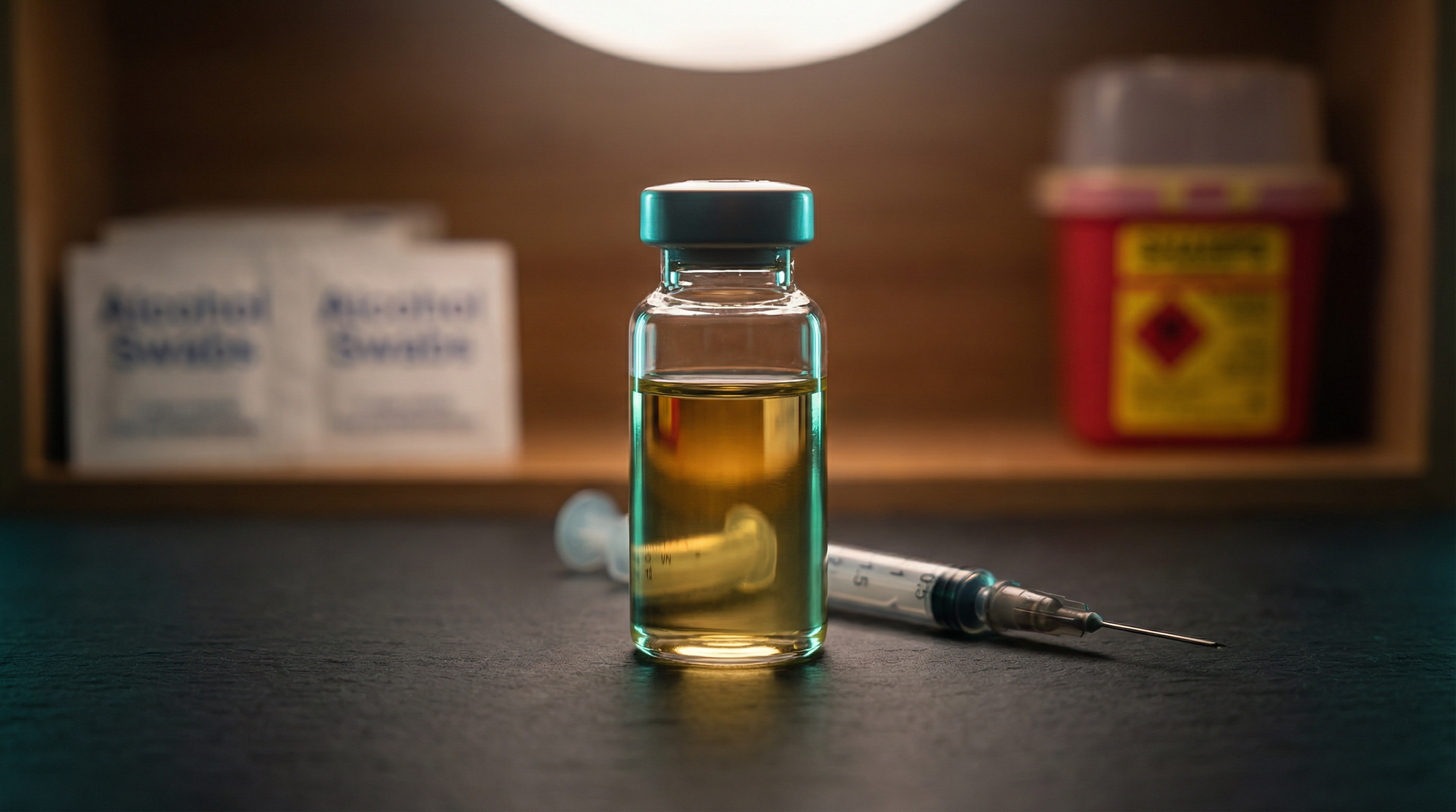
Before you learn how to inject testosterone, you need the right supplies on hand. Don't wing it. Here's your checklist:
- Testosterone vial — your prescribed testosterone (typically test cyp or enanthate). Store at room temperature, away from direct sunlight.
- Drawing needle — a larger gauge needle (18g or 20g) used to pull testosterone out of the vial. This is NOT the needle you inject with.
- Injection needle — a thinner gauge needle for the actual injection. Your doctor will specify the gauge and length based on your injection type (SubQ or IM).
- Syringe — typically 1mL or 3mL. Luer-lock syringes are ideal because the needle locks into place instead of just pressing on.
- Alcohol swabs — for cleaning the vial top and injection site.
- Sharps container — a puncture-proof container for disposing of used needles. You can buy one at any pharmacy, or your doctor's office may provide one.
- Band-Aid or gauze pad — for applying pressure after you inject.
Pro tip: Order supplies in bulk. Running out of needles the morning of your injection is an annoying problem you don't need. Most pharmacies and online medical supply stores sell multi-packs.
Get everything laid out before you start. Once you're holding a loaded syringe, you don't want to be rummaging through a drawer for an alcohol swab.
SubQ vs. IM: Which Injection Type Are You Using?
Before you learn how to give yourself a testosterone shot, you need to know which type of injection your protocol calls for. There are two options:
SubQ (subcutaneous) — the needle goes into the fat layer just under your skin. Common sites include the belly (avoiding the navel area), love handles, and the fatty area of the deltoid. SubQ uses shorter, thinner needles and is generally considered less intimidating for beginners.
IM (intramuscular) — the needle goes into muscle tissue. Common sites include the glute (ventrogluteal), quad (vastus lateralis), and deltoid. IM injections use slightly longer needles to reach the muscle.
Most modern TRT protocols have shifted toward SubQ injections, especially for guys injecting smaller, more frequent doses. But your doctor prescribed one or the other for a reason — stick with their recommendation.
If you're unsure which type you're supposed to be doing, call your prescribing doctor before your first pin. This isn't something to guess on.
Step-by-Step: How to Give Yourself a Testosterone Shot
Here's the actual process. This applies whether you're doing SubQ or IM — the injection technique itself varies slightly (covered in the next two sections), but the prep is the same.
-
Wash your hands thoroughly. Soap, warm water, at least 20 seconds. Dry with a clean towel. This is basic infection prevention — don't skip it.
-
Warm the vial (optional but helpful). Testosterone oil — especially test cyp — can be thick. Roll the vial between your palms for 30–60 seconds to warm it slightly. This makes it easier to draw and more comfortable to inject. Don't microwave it. Don't run it under hot water. Just body heat from your hands.
-
Wipe the vial top with an alcohol swab. Even if nobody else touches your vial, do this every time.
-
Draw air into the syringe. Pull the plunger back to the amount you're going to inject (e.g., if your dose is 0.3mL, draw 0.3mL of air). This creates positive pressure in the vial, making it easier to draw the oil.
-
Insert the drawing needle into the vial and inject the air. Push the air into the vial, then flip the vial upside down with the needle still in it.
-
Draw your dose. Pull the plunger back slowly past your prescribed amount, then push it back to the exact line. This helps clear any air bubbles. If you see a stubborn bubble, flick the syringe barrel with your fingernail and push it out.
-
Switch to your injection needle. Remove the drawing needle and twist on your injection needle. This keeps the injection needle sharp — drawing through a rubber stopper dulls the tip, and a dull needle means more discomfort going in.
-
Clean the injection site. Swab the area with alcohol in a circular motion from center outward. Let it air dry for a few seconds — injecting through wet alcohol stings.
-
Inject. Follow the SubQ or IM technique in the sections below.
-
Remove the needle smoothly. Pull straight out at the same angle you went in. Don't wiggle it.
-
Apply pressure. Press a gauze pad or cotton ball against the site for 10–15 seconds. A tiny drop of blood or oil at the surface is completely normal.
-
Dispose of the needle in your sharps container. Immediately. Don't recap, don't set it on the counter, don't toss it in the trash. Sharps container, every time.
That's the full process. It takes about 5 minutes once you've done it a few times. The first time might take 15–20 minutes because you're being careful, and that's exactly the right approach.
Injection Sites: Where to Inject Testosterone
There are three primary injection sites most TRT protocols use:
- Deltoid (shoulder) — works for both SubQ and IM. Easy to access, good for smaller volume injections.
- Quad / Vastus Lateralis (outer thigh) — a large muscle with easy self-access. Common for IM injections.
- Glute / Ventrogluteal (hip/upper glute) — the classic IM injection site. Large muscle, minimal nerves, but harder to reach on your own.
Site rotation is critical. Injecting the same spot repeatedly leads to scar tissue buildup, which makes injections harder and more uncomfortable over time. Rotate between sites consistently.
We wrote a full deep-dive on every injection site, how to locate them, and how to build a rotation schedule: TRT Injection Site Guide: Where to Inject and How to Rotate.
SubQ Injection Technique
If your protocol calls for SubQ, here's how to administer a testosterone shot into the subcutaneous fat layer:
-
Choose your site. Belly (at least 2 inches from your navel), love handle area, or the fatty part of your outer delt.
-
Pinch the fat. Use your non-dominant hand to pinch a fold of skin and fat between your thumb and forefinger. Hold it throughout the injection.
-
Insert the needle at a 45-degree angle. A smooth, steady motion — don't jab. The needle should slide in easily with a short, thin SubQ needle.
-
Inject slowly. Push the plunger at a steady, controlled pace. Testosterone oil is thick, so this takes a few seconds. Rushing it can cause discomfort and increases the chance of the oil leaking back out (called subcutaneous leak).
-
Hold for 5 seconds. After the plunger is fully depressed, keep the needle in place for about 5 seconds. This lets the oil settle into the tissue before you withdraw.
-
Release the pinch, remove the needle, apply pressure.
SubQ injections are popular for a reason — they're less intimidating, use smaller needles, and work great for the smaller volumes typical in frequent injection protocols (E3.5D or EOD dosing). Some guys report less post-injection soreness with SubQ compared to IM.
IM Injection Technique
If your doctor prescribed intramuscular injections, here's how to properly inject testosterone into the muscle:
-
Choose your site. Deltoid, vastus lateralis (outer quad), or ventrogluteal (upper glute/hip).
-
Stretch the skin. Use the Z-track method: pull the skin to one side with your non-dominant hand before inserting the needle. This creates an offset path that prevents oil from leaking back along the needle track after you withdraw.
-
Insert the needle at a 90-degree angle. Straight in, with a firm and confident motion. Hesitating halfway makes it worse.
-
Aspiration (the debate). Older guidelines told you to pull back on the plunger to check for blood before injecting. Most modern clinical guidelines — including the CDC and WHO — no longer recommend aspiration for IM injections in standard sites. That said, if your doctor told you to aspirate, follow their instructions.
-
Inject slowly and steadily. Same as SubQ — controlled pace, no rushing. IM injections with thicker oil may take 10–15 seconds to fully depress the plunger. That's fine.
-
Hold for 10 seconds. Keep the needle in place after injecting to let the oil disperse into the muscle.
-
Release the skin, remove the needle, apply pressure.
It's normal to feel a mild ache at the injection site for a day or two after IM injections, especially in the quads. This is called post-injection pain (PIP) and it's usually nothing to worry about. Warming the oil before injection and injecting slowly both help reduce PIP.
How Often Do You Need to Inject?
Injection frequency depends entirely on your prescribed protocol and the ester you're using. Common TRT schedules include:
- Once weekly — a standard starting protocol for many clinics.
- Twice weekly (E3.5D) — inject every 3.5 days (e.g., Monday morning, Thursday evening). This is increasingly popular because it produces more stable blood levels with fewer peak/trough swings.
- Every other day (EOD) — common with SubQ protocols and lower-dose approaches. Provides the most stable levels but requires more frequent injections.
More frequent injections generally mean more stable testosterone levels, which can mean fewer side effects and a more consistent sense of how you feel day to day. But "more frequent" isn't automatically better for everyone — your doctor is the one who should be dialing this in based on your labs and how you respond.
We break down injection frequency in detail — including how to know if your current schedule is working: How Often Should You Inject Testosterone?
Common First-Timer Mistakes
Most injection mistakes aren't dangerous — they're just things that make the process harder or more uncomfortable than it needs to be. Here are the ones to avoid:
-
Using the same needle to draw and inject. Drawing through the rubber stopper dulls the needle. Always switch to a fresh injection needle. The difference in comfort is significant.
-
Injecting cold oil. Cold testosterone is thicker and harder to push through a small-gauge needle. It also tends to cause more post-injection soreness. Roll the vial between your palms for a minute before drawing.
-
Not rotating injection sites. This one catches up with you over time. Repeatedly injecting the same spot causes scar tissue and hard lumps. Set up a rotation and stick to it.
-
Forgetting which site you used last. Two weeks from now, you won't remember if your last shot was left delt or right quad. If you're not tracking your sites, you'll default to the same spot — and that leads back to the scar tissue problem.
-
Hesitating mid-insertion. Pushing a needle in slowly or stopping halfway through is more painful than a confident, smooth insertion. Commit to the motion.
-
Improper needle disposal. Used needles go in a sharps container. Not the trash, not a plastic bottle, not the counter. Every time.
-
Skipping the alcohol swab. It takes five seconds. Infection risk is low, but it's not zero — and an injection site infection is genuinely miserable.
All of these are easy to fix once you're aware of them. After your first few injections, most of this becomes muscle memory.
Tracking Your Injections (Don't Skip This)
Here's the thing most guys don't think about until they wish they had: tracking matters more than technique once you've got the basics down.
Why? Because TRT isn't a single event — it's a protocol you'll follow for years. And the difference between "going through the motions" and "being dialed in" comes down to data.
Site rotation tracking prevents scar tissue. If you're logging which site you used each injection, you can rotate evenly across all your sites instead of defaulting to whatever feels most comfortable. Your future self will thank you when you don't have a lumpy delt.
Timing consistency reveals your peak and trough patterns. If you always feel off by Thursday afternoon on a Monday/Thursday E3.5D schedule, that's useful information for your next doctor's visit. But only if you actually logged when you injected, not just what day you think it was.
Dose and volume records make lab reviews easier. When your doctor asks "have you been consistent with your protocol?" — you can show them, not guess.
Supply tracking prevents the "I'm out of test and my pharmacy needs 3 business days" problem. Knowing exactly how many injections are left in your vial means you can reorder on time, every time.
The guys who get the best results on TRT aren't the ones with the fanciest protocol — they're the ones who are consistent and have the data to prove it.
Once you've nailed the technique, the next challenge is consistency. Himcules is a TRT tracking app built specifically for this — one-tap injection logging, automatic site rotation, and smart reminders so you never wonder "did I already inject today?" Download Himcules on iOS
You know how to inject testosterone now. Next step: learn where to inject it. Read our full TRT Injection Site Guide for detailed breakdowns of every site, or check out How Often Should You Inject Testosterone? to make sure your frequency is dialed in.
References
Related Reading
Himcules is a personal tracking tool, not a medical device. Nothing in this article constitutes medical advice. Always consult your healthcare provider about your specific TRT protocol.