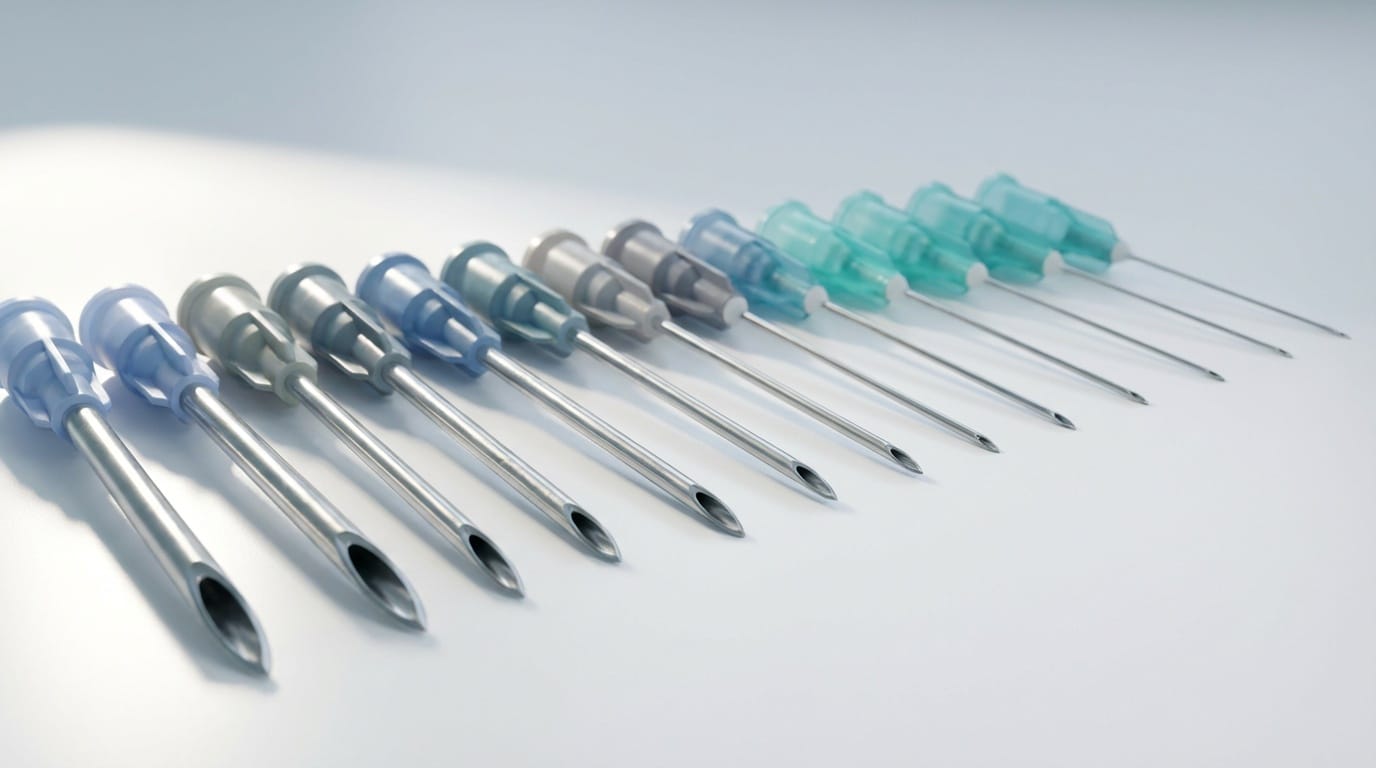
What Gauge Needle for Testosterone Injections? The Clear, No-Nonsense Guide Men Actually Need
Choosing the right needle for testosterone injections matters more than most guys realize. In recent studies, about 62.7% of patients said they were satisfied with their current testosterone replacement therapy (TRT) regimen, and comfort and ease of injections were major reasons why. In our work helping men track and manage their TRT schedules, we see the same thing: when needle size, length, and schedule are dialed in, people stick with therapy and feel better.
Key Takeaways
| Question | Short Answer |
|---|---|
| What gauge needle is most common for testosterone? | Most men use 23–25 gauge needles for intramuscular testosterone injections. Thicker oils may need 23G; thinner formulations can use 25G. |
| What length needle for glute vs. thigh? | Glute (butt) shots usually use 1–1.5 inch needles; thigh (vastus lateralis) often uses 1 inch, depending on body fat. |
| Can I use a smaller (higher gauge) needle? | Yes, many protocols now use 25–27G needles, especially for subcutaneous or shallow IM injections, if the oil is not too thick. |
| How does frequency affect needle choice? | More frequent injections (EOD, E3.5D) usually push men toward thinner, smaller needles to reduce soreness, which is exactly what our Himcules TRT tracking app is designed to help you manage. |
| Does needle gauge affect absorption? | Gauge mainly affects comfort and injection speed. Correct depth and site (IM vs. subQ) matter more for how testosterone is absorbed. |
| How do I remember what gauge and site I used? | We recommend logging your injections and site rotation. Our app is built to track TRT, rotate sites, and schedule doses so you don’t guess every week, as explained on our TRT tracking blog. |
| Is this medical advice? | No. We don’t provide medical advice. Our Terms of Service make it clear you must work with your clinician to finalize needle size and technique. |
1. Understanding Needle Gauge for Testosterone: What the Numbers Really Mean
Gauge can feel confusing at first because the numbers run backward: the higher the gauge, the thinner the needle. A 21G is thicker than a 25G, and a 27G is thinner than both. For testosterone injections, we balance three things: oil thickness, comfort, and injection depth.
Testosterone cypionate and enanthate are oil-based and relatively thick. That’s why old-school protocols often used 21–23G needles. Today, many men safely use 23–27G, depending on whether they inject intramuscularly (IM) or subcutaneously (subQ), and what their prescriber recommends.
How Gauge Affects Your Injection Experience
- Lower gauge (18–22G): Thicker, faster injection, more tissue trauma, more soreness.
- Mid gauge (23–25G): Common sweet spot for TRT IM injections.
- Higher gauge (26–30G): Thinner, less painful, slower to push oil; often used for subQ or shallow IM.
2. Typical Needle Gauge and Length for Common Testosterone Injection Sites
The “right” needle is not just about gauge; site and depth matter as much. Glute injections usually require longer needles to reach the muscle through fat. Thigh and deltoid injections can often use shorter lengths.
Here’s what most prescribers commonly recommend, which you should always confirm with your clinician:
| Site | Route | Common Gauge | Typical Length |
|---|---|---|---|
| Glute (upper outer buttock) | Intramuscular (IM) | 23–25G | 1–1.5 inch |
| Thigh (vastus lateralis) | IM | 23–25G | 1 inch |
| Deltoid (shoulder) | IM | 25G | 5/8–1 inch |
| Abdomen / love handle area | SubQ | 25–27G | 1/2–5/8 inch |
3. Intramuscular vs. Subcutaneous Testosterone: How Route Changes Needle Gauge
Your injection route has a big impact on needle choice. Intramuscular (IM) injections place testosterone deep in the muscle, while subcutaneous (subQ) injections place it in the fat layer just under the skin. Both can work effectively under medical guidance.
Many men still start with IM injections, but subQ has become more common, especially for men injecting multiple times per week. SubQ usually allows for thinner, higher-gauge needles, which often feel less painful.
Common Gauge Ranges by Route
- IM testosterone: 22–25G, 1–1.5 inch; larger body fat may need longer length.
- SubQ testosterone: 25–27G, 1/2–5/8 inch; often in the abdomen or flank.
Always confirm route, gauge, and length with your prescriber. Our role is to help you track what you actually use so you and your clinician can review it clearly.
4. How Viscosity and Dose Size Affect What Gauge Needle You Use
Not all testosterone injections feel the same because not all solutions and doses are equal. Thick oil at a high dose through a very thin needle can be slow and frustrating. Thin oil at a lower dose can go through a smaller needle easily.
Common testosterone concentrations (like 100 mg/mL or 200 mg/mL) are usually in oil carriers such as cottonseed, grapeseed, or sesame oil. These are all “thick,” but some brands feel slightly thinner, allowing higher gauge needles.
Practical Rules of Thumb
- Higher doses (e.g., 200 mg in one shot) may push you toward 23–25G for reasonable injection time.
- Split doses (e.g., 60–80 mg multiple times per week) often allow 25–27G because each injection volume is smaller.
- If you struggle to push the plunger, you may need a slightly lower gauge (thicker) needle, with your clinician’s approval.
5. Comfort vs. Control: Balancing Pain, Bruising, and Injection Speed
When men ask us “What gauge needle for testosterone?”, what they really want is a way to reduce pain and soreness without making injections impossible to push. Thicker needles move oil quickly but can hurt more going in and coming out. Thinner needles hurt less going in but require patience.
We encourage users to track not just dates and doses, but also subjective comfort with different needle sizes. Over a few weeks, you can see whether 23G vs. 25G vs. 27G gives you the best blend of comfort and practicality.
Tips to Improve Comfort Regardless of Gauge
- Let the testosterone vial come to room temperature before drawing.
- Inject slowly; forcing oil in too fast can cause deeper soreness.
- Keep your muscle relaxed and avoid flexing during injection.
- Rotate injection sites consistently to avoid scar tissue buildup.
6. Why Site Rotation Matters as Much as Gauge (and How We Help Track It)
Even with the perfect gauge, repeatedly hitting the same spot can lead to scar tissue, lumps, or soreness. That’s where structured site rotation comes in. We built our system specifically to keep you from guessing which glute, quad, or subQ spot you used last.
For most protocols, we suggest a rotation pattern such as left glute → right glute → left quad → right quad, or a similar series for subQ abdomen sites. Once you combine this with consistent needle length and gauge, injections often feel far more predictable.
Needle Gauge + Rotation = Long-Term Comfort
- Choose a gauge and length approved by your prescriber.
- Log every injection: date, dose, site, and needle size.
- Review your log with your clinician if issues arise (pain, bleeding, or nodules).
7. Drawing Needle vs. Injection Needle: Why Many Men Use Two Different Gauges
Many TRT patients don’t use the same needle to draw from the vial and to inject. A thicker drawing needle can make filling the syringe easier, while a thinner injection needle keeps the actual shot more comfortable.
This “two-needle system” is common in clinics and at home. It lets you take advantage of a lower gauge (thicker) needle to handle viscous oil quickly while still using a higher gauge (thinner) needle for the injection itself.
Example Setup (Always Confirm with Your Clinician)
- Draw with: 18–21G, 1 inch needle.
- Inject with: 23–25G for IM, or 25–27G for subQ/shallow IM.
- Swap needles after drawing, before you clean the skin and inject.
8. Frequency of Testosterone Injections and Its Impact on Needle Gauge Choice
Injection frequency is another key factor in deciding what gauge needle to use. Once-weekly or biweekly injections mean fewer pokes, so some men tolerate a slightly thicker needle. But as protocols move toward E3.5D, EOD, or even daily micro-dosing, comfort becomes crucial.
Many men who inject more frequently naturally transition to thinner needles and often subQ routes, under medical supervision. Tracking how each frequency and gauge combination feels week over week helps you and your prescriber fine-tune the plan.
Common Patterns We See Users Track
- Weekly IM: 23–25G, 1–1.5 inch, glute or thigh.
- E3.5D IM or shallow IM: 25G, 1 inch, thigh or delt.
- Frequent subQ (3–7x/week): 25–27G, 1/2–5/8 inch, abdomen/flanks.
9. Safety, Privacy, and Documentation Around Your Needle Choice
Needle gauge is not just a comfort question; it’s a safety and documentation question. You should always follow your prescriber’s directions, use sterile technique, and keep a clear record of what you actually did, especially if your regimen changes over time.
Because our platform keeps data on your device by default and doesn’t sell your information, you can comfortably track sensitive details like dose, frequency, gauge, and route while keeping that history ready to share with your clinician when needed.
Key Safety Practices
- Never reuse needles.
- Dispose of sharps in a proper container.
- Note any bleeding, pain, or unusual swelling next to your logged injection.
- Review patterns with your clinician if problems recur at the same gauge or site.
10. Putting It All Together: Example Needle Setups for Different TRT Scenarios
To make this practical, we’ll walk through a few example scenarios. These are not prescriptions, but they reflect common patterns we see men discuss with their clinicians. Always verify details with your own provider.
| Scenario | Possible Gauge & Length | Notes |
|---|---|---|
| Standard weekly IM, glute | 23–25G, 1–1.5 inch | Good for moderate volume; track soreness and adjust if needed. |
| E3.5D IM, thigh | 25G, 1 inch | Balanced comfort; easier site access for self-injection. |
| Frequent subQ micro-dosing | 25–27G, 1/2–5/8 inch | Smaller volumes; prioritize comfort and consistency. |
| High-dose single weekly injection | 23G, 1–1.5 inch | Thicker needle may be needed for volume; consider split doses instead. |
We encourage you to log whatever setup you and your clinician choose, then review your comfort, energy, and symptoms over time. Needle gauge is a small detail, but it can make staying consistent with TRT much easier.
Track Your TRT Protocol
Stop guessing. Start tracking. Your TRT protocol deserves better than spreadsheets.
Download HimculesRelated Reading:
Conclusion
When you ask “What gauge needle for testosterone?”, you’re really asking how to make TRT workable over the long haul. For most men, that means somewhere in the 23–25G range for IM and 25–27G for subQ, with needle length adjusted for body fat and injection site.
The best gauge for you is the one your clinician approves that you can use consistently, comfortably, and safely. Our role is to help you log your injections, manage your schedule, and rotate sites so that once you and your provider choose the right needle, you can stick with it and focus on how you feel—not on remembering which side you used last week.