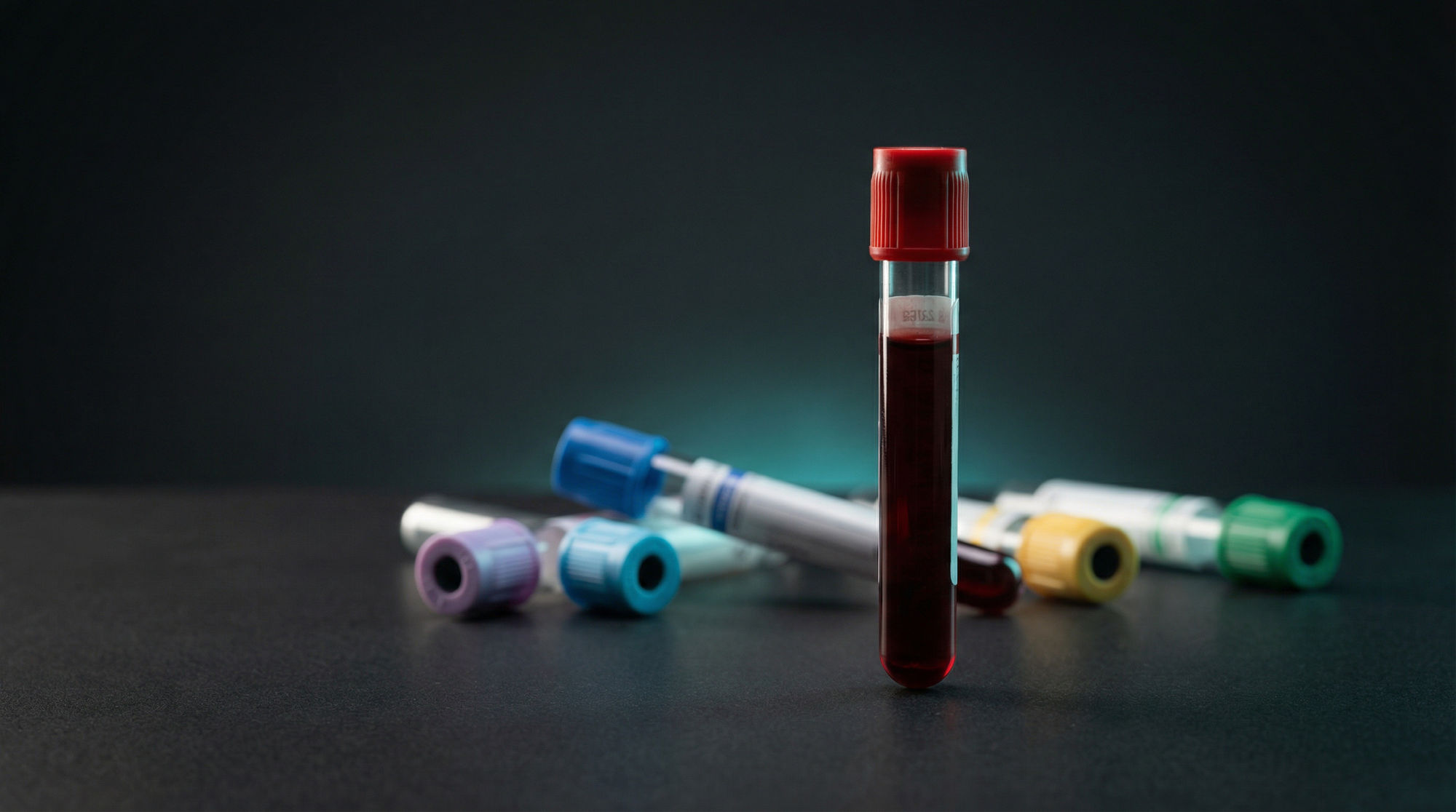
Your doctor ordered blood work. You got the results. Now you're staring at a wall of numbers wondering what half of them mean and whether you should be concerned about the ones highlighted in red. TRT blood work isn't complicated — but it's often poorly explained.
This guide covers every lab marker that matters for men on testosterone therapy: what each test measures, what the numbers should look like, when to test, and what to do when something's off. Consider it your reference manual for every lab visit from here on out.
Key Takeaways
| Essential panel | Total T, Free T, Estradiol (sensitive), Hematocrit/CBC, PSA, Metabolic Panel |
| When to test | Baseline, 6-8 weeks after starting, 3 months, 6 months, then every 6-12 months |
| Timing matters | Draw blood at trough — morning of injection day, before your shot, fasted |
| Critical thresholds | Hematocrit above 54% = dose reduction; PSA rapid rise = urology referral; Estradiol out of range = protocol adjustment |
When to Get Blood Work on TRT
The Endocrine Society Guidelines recommend this monitoring schedule:
- Baseline — Before starting TRT (this is your reference point for everything)
- 6-8 weeks — First check after starting (steady state achieved for cypionate/enanthate)
- 3 months — Confirm levels are stable, check hematocrit
- 6 months — Full panel reassessment
- 12 months — Annual comprehensive panel
- Annually thereafter — Or sooner if dose changes
Critical rule: always draw at trough. That means the morning of your injection day (or the day before), before your shot, first thing in the morning, fasting. Drawing blood mid-cycle or after an injection gives you misleadingly high numbers that don't reflect your actual hormonal baseline.
The Essential TRT Blood Panel
Total Testosterone
This is the headline number — total testosterone in your blood, measured in ng/dL. It includes both bound (to SHBG and albumin) and unbound (free) testosterone.
Target range on TRT: 400-700 ng/dL at trough. Some men feel best at 500, others need 700. The AUA aims for the mid-normal range (450-600 ng/dL).
If too low at trough: Dose may need increasing, or absorption may be an issue. Check injection technique and site.
If too high at trough: You're overdosed. High trough means your peaks are even higher, increasing side effect risk. Reduce dose or increase frequency.
Free Testosterone
Only 1-3% of your total testosterone circulates unbound ("free") and is biologically active. Free T is arguably more important than total T because it's what your cells actually use.
Target range: Generally 15-25 pg/mL by equilibrium dialysis (the gold standard method). Different assays give different ranges — always compare against the lab's reference range.
When total T is normal but free T is low: SHBG is likely elevated, binding up too much testosterone. This is common in older men, men on certain medications, and those with liver conditions.
SHBG (Sex Hormone-Binding Globulin)
SHBG is the carrier protein that binds testosterone, rendering it inactive. Think of it as a sponge — the more SHBG you have, the less free testosterone is available to your tissues.
Normal range: 10-57 nmol/L. On TRT, the relevant question is whether your SHBG is so high that your free T is too low despite adequate total T.
High SHBG (above 50): You may need a higher total T to maintain adequate free T. More frequent injections can help because smaller, steadier doses produce less SHBG stimulation.
Low SHBG (below 20): You'll have higher free T relative to total T. These men often do well on lower doses but may need more frequent injections to avoid large peaks.
Estradiol (E2) — Sensitive Assay
Estradiol is the primary estrogen in men. It's produced by aromatization of testosterone and is essential for bone health, brain function, and cardiovascular protection. The goal isn't to eliminate estradiol — it's to keep it proportional to testosterone.
Target range: 20-40 pg/mL (via sensitive LC-MS/MS assay). The standard immunoassay is less accurate in men — always request the sensitive estradiol test.
High estradiol (above 50 pg/mL): Symptoms include water retention, mood swings, nipple sensitivity, and erectile issues. Solutions: reduce dose, increase injection frequency (lower peaks = less aromatization), or discuss aromatase inhibitor with your doctor.
Low estradiol (below 15 pg/mL): Joint pain, fatigue, low libido, mood issues. This can happen from excessive AI use or naturally low aromatization. Estradiol is protective — don't tank it.
Hematocrit and CBC (Complete Blood Count)
Hematocrit measures the percentage of your blood volume occupied by red blood cells. Testosterone stimulates erythropoiesis, which means your hematocrit will likely rise on TRT.
Normal range: 38-50%. The Endocrine Society sets the intervention threshold at 54%.
If hematocrit exceeds 54%: Your blood is too thick, increasing clot risk. Options include dose reduction, more frequent injections (some evidence suggests steadier levels reduce RBC stimulation), or therapeutic phlebotomy (donating blood).
Hemoglobin is tracked alongside hematocrit and generally moves in the same direction. Normal: 13.5-17.5 g/dL.
PSA (Prostate-Specific Antigen)
PSA is a screening marker for prostate health. TRT does not cause prostate cancer (this has been well-established), but it can accelerate the growth of existing prostate cancer. That's why baseline and ongoing monitoring are mandatory.
Normal range: Under 4.0 ng/mL (age-dependent). More important than the absolute number is the rate of change.
Red flags: PSA increase above 1.4 ng/mL within 12 months, or any value above 4.0, warrants urology referral per the AUA guidelines. A modest rise (0.3-0.5 ng/mL) in the first year is common and usually not concerning.
Comprehensive Metabolic Panel
This panel covers liver enzymes (AST, ALT), kidney function (creatinine, BUN), blood glucose, and lipids. While injectable testosterone bypasses the liver (unlike oral formulations), metabolic monitoring remains important.
Key markers:
- Liver enzymes (AST, ALT) — should remain in normal range. Elevations suggest investigating non-TRT causes
- Fasting glucose and HbA1c — TRT can improve insulin sensitivity; track the improvement
- Lipid panel — monitor total cholesterol, LDL, HDL, triglycerides. TRT can modestly decrease HDL; track the trend
- Creatinine — kidney function baseline
Advanced Markers (Worth Tracking)
DHT (Dihydrotestosterone)
DHT is the more potent androgen converted from testosterone via 5-alpha reductase. It's responsible for androgenic effects including prostate growth and male-pattern hair loss. Not all doctors order this, but if you're concerned about hair loss or prostate symptoms, DHT levels provide useful context.
Prolactin
Elevated prolactin can cause sexual dysfunction, fatigue, and gynecomastia. While not directly caused by TRT, it's worth checking at baseline and if you develop unexplained symptoms.
Thyroid Panel (TSH, Free T3, Free T4)
Thyroid dysfunction can mimic TRT failure — fatigue, weight gain, brain fog despite adequate testosterone levels. If you're not responding to TRT as expected, thyroid function should be evaluated.
Vitamin D and Ferritin
Low vitamin D is extremely common in hypogonadal men and can independently cause fatigue and mood issues. Ferritin (iron stores) matters if you're donating blood regularly to manage hematocrit — you can become iron-deficient.
How to Read Your Results Like a Pro
Context Matters More Than Numbers
A single blood draw is a snapshot. Trends matter more than any individual reading. If your hematocrit was 48% at baseline, 50% at 3 months, and 52% at 6 months — that's a trend worth discussing even though all values are "normal." If your estradiol jumped from 25 to 45 after a dose increase, that tells a story.
This is why tracking lab results over time is essential. Our guide on testing frequency covers the optimal monitoring schedule in more detail.
The Ratio Approach
Some clinicians look at the testosterone-to-estradiol ratio rather than absolute numbers. A commonly cited target is a T:E2 ratio of 20:1 to 30:1 (e.g., total T of 600 ng/dL with estradiol of 20-30 pg/mL). While not universally endorsed in guidelines, this framework can help identify relative estrogen excess.
Trough vs Peak Confusion
If your blood was drawn 24 hours after your injection (near peak), your total T might read 1200 ng/dL. That same person's trough might be 500 ng/dL. Both numbers are "yours," but they tell very different stories. Consistency in timing is crucial for comparing results across lab visits.
Building Your Lab Tracking System
Every time you get bloodwork, record:
- Date and time of blood draw
- Days since last injection (to identify where in your cycle the draw occurred)
- All relevant values (Total T, Free T, E2, Hematocrit, PSA, metabolic panel)
- Current dose and injection frequency
- Any symptoms you're experiencing
When you can lay out 4-6 lab results side by side with injection timing and symptom data, patterns emerge that would be invisible from any single lab report. Your doctor can make precise adjustments instead of guessing.
Himcules tracks your injection schedule and protocol details, giving you the injection timing context that makes lab results actionable. Knowing that your blood was drawn on day 7 of a 7-day cycle (true trough) versus day 3 (mid-cycle) changes the interpretation of every number on your report.
Common Lab Result Scenarios
Scenario 1: Total T Good, Symptoms Persist
Your total T is 600 ng/dL but you still feel fatigued and low-libido. Check free T and estradiol. High SHBG could be binding your testosterone, or elevated estradiol could be dampening the androgenic effects. Also evaluate thyroid function and vitamin D.
Scenario 2: Hematocrit Creeping Up
Common trajectory: 46% to 49% to 52%. Not alarming yet, but trending toward the threshold. Consider increasing injection frequency (steadier levels may reduce erythropoietic drive), staying well-hydrated, and scheduling a blood donation. Recheck in 6-8 weeks.
Scenario 3: Estradiol Too High
Estradiol at 55 pg/mL with symptoms (water retention, mood swings). Before reaching for an AI, try splitting your dose into more frequent injections. Increasing injection frequency lowers peaks, which reduces aromatization naturally.
References
- Endocrine Society Clinical Practice Guidelines — Testosterone Therapy (2018)
- AUA Guidelines on Testosterone Deficiency (2018)
- FDA Prescribing Information — Depo-Testosterone (Testosterone Cypionate)
- Cleveland Clinic — Low Testosterone (Male Hypogonadism)
- Harvard Health — Is Testosterone Therapy Safe?
Related Reading
Himcules is a personal tracking tool, not a medical device. Nothing in this article constitutes medical advice. Always consult your healthcare provider about your specific TRT protocol.