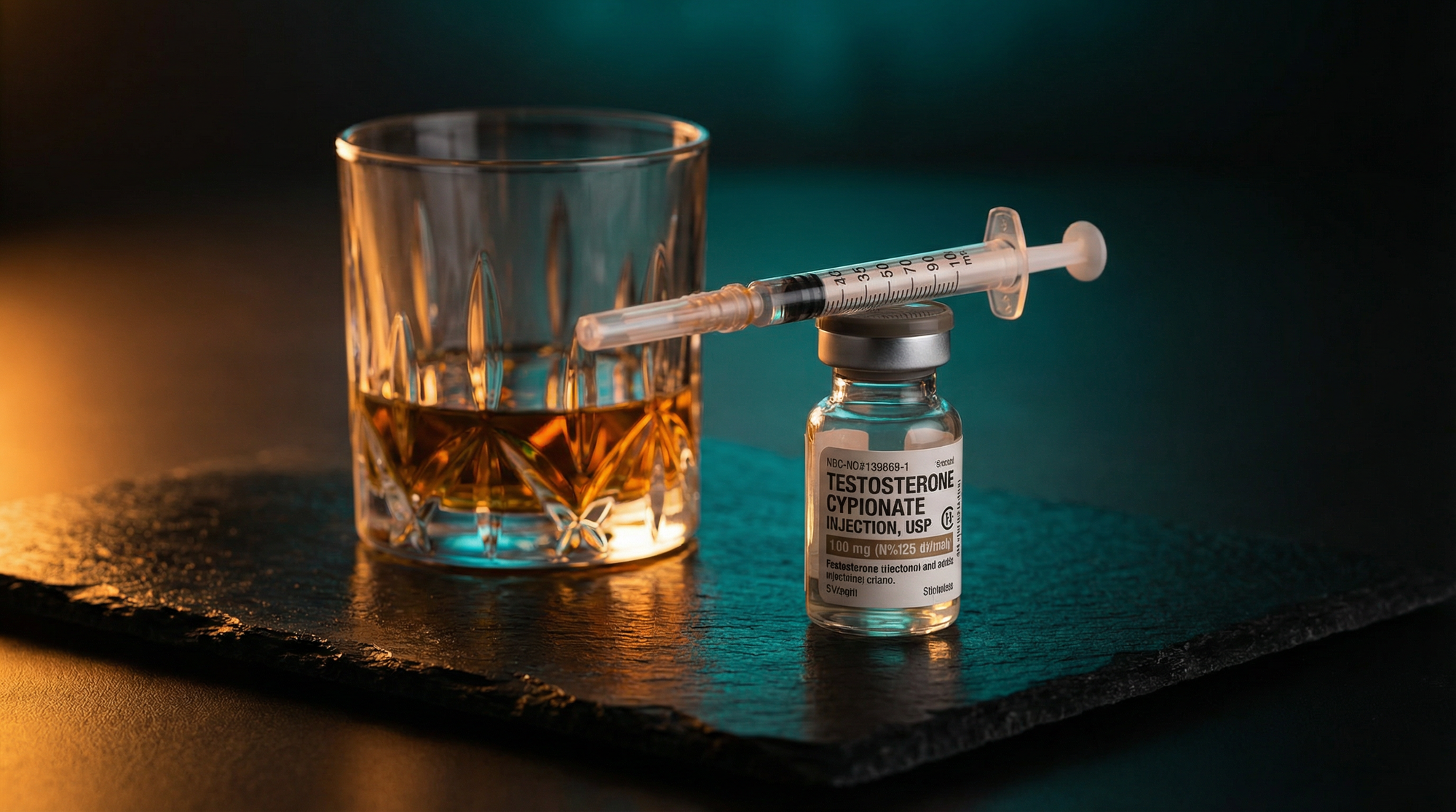
Yes, most men on TRT can drink alcohol in moderation — but alcohol directly interferes with testosterone production, liver metabolism, and estrogen balance in ways that can quietly undermine your therapy. Research shows that even moderate drinking (two drinks per day) can reduce testosterone levels by up to 6.8% over three weeks.
That doesn't mean you have to swear off every beer at a barbecue. It means you need to understand exactly what happens when alcohol meets exogenous testosterone, how much is too much, and what to watch for in your labs. This guide covers all of it with real numbers, not just vague "drink responsibly" advice.
Does Alcohol Actually Lower Testosterone?
Alcohol lowers testosterone through multiple mechanisms that start working within hours of your first drink. A 2019 meta-analysis published in Drug and Alcohol Dependence found a clear dose-response relationship: light drinking had minimal effect, but moderate-to-heavy consumption significantly suppressed testosterone in men (Rachdaoui & Sarkar, 2017).
Here's what happens biologically. Alcohol damages Leydig cells in the testes — the cells responsible for about 95% of your testosterone production. It also increases the activity of aromatase, the enzyme that converts testosterone into estrogen. And it disrupts the hypothalamic-pituitary-gonadal (HPG) axis, which is the hormonal signaling chain that tells your body how much testosterone to produce.
The Dose Matters More Than the Drink
Studies break down the impact roughly like this:
| Drinking Level | Drinks/Day | Testosterone Impact |
|---|---|---|
| Light | 1 or fewer | Minimal — some studies show a small temporary increase |
| Moderate | 2–3 | 6–10% reduction after consistent use over weeks |
| Heavy | 4+ | Up to 45% reduction; Leydig cell damage may become chronic |
| Binge (single event) | 5+ in 2 hours | Acute suppression lasting 12–24 hours |
A study in Alcoholism: Clinical and Experimental Research found that men who consumed roughly 1.5 g of alcohol per kilogram of body weight (about 7 standard drinks for a 180-pound man) saw testosterone drop by 23% within 16 hours (Sarkola & Eriksson, 2003).
Did You Know? Light alcohol consumption (one drink or less per day) has actually been associated with slightly higher testosterone in some studies. Researchers believe this is due to a temporary ethanol-related decrease in testosterone clearance by the liver — not increased production.
How Alcohol Interacts with TRT Specifically
Alcohol competes with exogenous testosterone for the same liver metabolic pathways, leading to less predictable hormone levels and increased estrogen conversion even when your testosterone comes from a vial, not your testes. Here's why that matters even on TRT.
When your liver is busy breaking down ethanol and acetaldehyde, it processes testosterone less efficiently. This can lead to two problems:
- Higher peak levels that drop faster — your injection-to-trough curve becomes less predictable
- Increased aromatization — more of your testosterone gets converted to estradiol because alcohol upregulates aromatase activity
On top of that, alcohol increases sex hormone-binding globulin (SHBG) with chronic use, which binds to free testosterone and makes it unavailable to your tissues. So even if your total testosterone looks fine on bloodwork, your free testosterone — the stuff that actually drives results — may be lower than it should be.
This is one reason some men on TRT feel great for a while, then plateau despite consistent doses. If you're experiencing that, take an honest look at your alcohol intake before assuming your dose needs adjusting. Our guide on how to know if your TRT dose is right covers the other signs to check.
Can You Drink Alcohol While on Testosterone Injections?
You can, but you should go in with clear expectations. No doctor will tell you alcohol is beneficial alongside TRT, but most TRT-prescribing physicians don't require total abstinence either. The consensus from endocrinology guidelines is moderation: no more than two standard drinks per day for men, and ideally not daily (Emanuele & Emanuele, 2001).
A "standard drink" means:
- 12 oz of beer (5% ABV)
- 5 oz of wine (12% ABV)
- 1.5 oz of spirits (40% ABV)
The practical rule most TRT clinicians follow: if you keep it under 7 drinks per week, spread out (not binged), and your bloodwork stays clean, alcohol isn't likely to derail your therapy. If you're regularly exceeding that, your estradiol, hematocrit, and liver enzymes will probably tell the story before you feel it.
Does Alcohol Increase Estrogen on TRT?
Yes — alcohol actively raises estrogen through at least three mechanisms that stack on top of TRT's own aromatization, making estrogen management significantly harder for men on testosterone therapy. Here's the chain reaction:
- Alcohol upregulates aromatase — the enzyme that converts testosterone to estradiol. More alcohol means more conversion (Purohit, 1998).
- Alcohol impairs liver estrogen clearance — your liver normally metabolizes and excretes excess estrogen. When it's processing alcohol, this function slows down.
- Beer contains phytoestrogens — hops contain 8-prenylnaringenin, one of the most potent known phytoestrogens. This is additive to your body's own estrogen production.
For men on TRT, this is particularly relevant because you're already producing estrogen via aromatization of your injected testosterone. Adding alcohol to the equation can push estradiol levels into a range where you notice symptoms: water retention, mood changes, sensitive or puffy nipples, and reduced libido.
If you're managing estrogen with an aromatase inhibitor (AI) like anastrozole, regular drinking may mean you need a higher dose — or it may mean the AI can't keep up. Either way, the cleaner your alcohol intake, the easier estrogen is to manage.
Did You Know? Hops-based beer has the highest estrogenic effect of any alcoholic drink. A study in Molecular Nutrition & Food Research found that 8-prenylnaringenin from hops is roughly 50 times more estrogenic than genistein from soy (Milligan et al., 2002).
How Much Alcohol Is Safe on TRT?
Most TRT clinicians consider 0–4 drinks per week the low-risk zone, with up to 7 per week (spread out, never binged) as the upper limit before bloodwork markers typically start shifting. Here's the full framework:
Low risk (minimal impact on TRT): - 0–4 drinks per week - No more than 2 in a single session - At least 2 alcohol-free days per week
Moderate risk (monitor bloodwork closely): - 5–10 drinks per week - Occasional sessions of 3+ drinks - May see elevated estradiol and liver markers
High risk (likely undermining TRT results): - 10+ drinks per week - Regular binge sessions (5+ drinks) - Expect elevated hematocrit, estradiol, and liver enzymes
The real answer depends on your individual metabolism, liver health, body composition, and TRT dose. A 220-pound man on 120 mg/week of testosterone cypionate will handle alcohol differently than a 160-pound man on 200 mg/week.
The best approach isn't guessing — it's tracking. Log your drinking alongside your symptoms and labs, then look for patterns. This is something most men never do, and it's one of the reasons the alcohol-TRT connection stays murky for so long.
What Happens to Your Blood Work When You Drink on TRT?
Alcohol on TRT shows up in seven key blood markers: free testosterone, estradiol, hematocrit, liver enzymes (ALT/AST), GGT, and SHBG — each shifting in ways that can mimic or mask protocol problems. Here's what to watch:
| Marker | What Alcohol Does | Why It Matters on TRT |
|---|---|---|
| Total Testosterone | Minimal effect if exogenous | Your injected dose dominates this number |
| Free Testosterone | May decrease (SHBG rises with chronic drinking) | The testosterone your body can actually use |
| Estradiol (E2) | Increases via aromatase upregulation | Can cause water retention, gynecomastia, mood issues |
| Hematocrit/Hemoglobin | May elevate (dehydration + TRT-induced erythrocytosis) | Already a TRT risk — alcohol compounds it |
| Liver Enzymes (ALT/AST) | Elevates with regular drinking | TRT is liver-neutral via injection, but oral testosterone + alcohol stresses the liver |
| GGT | Specific marker for alcohol-related liver impact | Elevated GGT + normal ALT/AST suggests alcohol as the cause |
| SHBG | Increases with chronic alcohol use | Binds free testosterone, reducing its effectiveness |
One practical tip: if you're getting bloodwork done, avoid alcohol for at least 72 hours before the draw. Acute alcohol use can temporarily spike liver enzymes and dehydrate you (artificially raising hematocrit), which muddies your results. Your doctor might flag issues that are actually just last Friday night.
For a deeper look at what testosterone levels mean at different ages, including lab ranges, see our dedicated guide.
Will Quitting Alcohol Increase Your Testosterone?
If you're currently drinking moderately or heavily, yes — quitting alcohol will almost certainly raise your testosterone levels, whether you're on TRT or not. The timeline depends on how much you've been drinking and for how long.
Expected recovery timeline after quitting:
- 24–48 hours: Acute testosterone suppression from your last drink reverses
- 2–4 weeks: SHBG levels begin to normalize, freeing up more bioavailable testosterone
- 1–3 months: Leydig cell function improves (for men not on TRT); liver enzyme levels return to baseline
- 3–6 months: Full hormonal rebalancing in men with previous heavy use
A 2022 study in JAMA Network Open following over 3,000 men found that those who quit or reduced alcohol showed measurable improvements in testosterone and metabolic markers within 6 months (Liang et al., 2022).
For men on TRT specifically, quitting alcohol won't raise your total testosterone (that's set by your injection dose), but it will improve your free testosterone, reduce estradiol, and make your overall protocol more effective. Many men report better sleep, mood, and body composition within weeks of cutting alcohol — benefits that amplify what TRT is already doing.
Best Alcohol Choices If You're on TRT
Red wine in small amounts and clear spirits with sugar-free mixers have the least hormonal impact for men on TRT, while beer — thanks to phytoestrogens from hops — is the worst choice. Here's how options compare:
Better choices: - Red wine (small amounts) — contains resveratrol, which has mild aromatase-inhibiting properties. A 5 oz glass is the standard. - Clear spirits (vodka, gin, tequila) — lower in congeners and additives. Mix with soda water, not sugary mixers. - Dry wines — lower sugar content than sweet wines or cocktails.
Worse choices: - Beer — hops contain phytoestrogens; beer also tends to be consumed in higher volume - Sugary cocktails — added sugar spikes insulin, which can increase fat storage and aromatization - Fortified wines and liqueurs — higher alcohol content per serving than most people realize
The calorie factor: Alcohol delivers 7 calories per gram with zero nutritional value. If you're on TRT partly for body composition benefits — and many men are — alcohol calories can quietly undermine your progress. Three beers on a Saturday adds roughly 450–600 empty calories. Over a month, that's a pound of fat you didn't need. Our article on whether TRT helps with weight loss goes deeper on the body composition connection.
How to Track Alcohol's Impact on Your TRT Results
Track every drink's type, quantity, and timing relative to your injection day alongside daily symptom ratings — most men who do this for 4–6 weeks discover clear patterns between alcohol intake and energy, libido, or bloodwork shifts. Here's a simple framework:
- Log every drink — type, quantity, and timing relative to your injection day
- Rate your symptoms daily — energy, libido, mood, sleep quality (1–10 scale)
- Note your injection timing — some men report worse alcohol tolerance in the 24–48 hours after an injection when levels peak
- Compare bloodwork — get labs after a 2-week no-alcohol stretch, then after a 2-week period of your normal drinking pattern. Compare estradiol, free T, and liver enzymes.
- Look for weekly patterns — many men find that drinking on the same day as their injection produces noticeably worse symptoms than drinking 3–4 days post-injection
This kind of pattern recognition is exactly what separates men who plateau from men who keep improving. If you track your alcohol, symptoms, and labs in the same place, the picture becomes obvious fast.
What Should You Avoid While on TRT Besides Alcohol?
Grapefruit juice, opioids, excessive caffeine, chronic sleep deprivation, and high-stress levels can all interfere with your TRT results — some by altering testosterone metabolism, others by raising cortisol that directly antagonizes your therapy. Here are the key ones:
- Grapefruit juice — inhibits CYP3A4, an enzyme involved in testosterone metabolism. Can alter how quickly your body processes testosterone.
- Opioids — suppress the HPG axis and significantly lower testosterone. If you're on TRT because of opioid-induced hypogonadism, continued opioid use undermines the therapy.
- Excessive caffeine — in extreme doses (600+ mg/day), caffeine can elevate cortisol, which antagonizes testosterone's effects. Normal coffee consumption is fine.
- Soy-heavy diets — phytoestrogens from soy can have mild estrogenic effects, though clinical significance is debated.
- Sleep deprivation — consistently getting under 6 hours of sleep reduces testosterone by 10–15% according to a University of Chicago study (Leproult & Van Cauter, 2011).
- Chronic stress — elevated cortisol directly suppresses testosterone production and can counteract TRT benefits.
For a complete rundown of what to watch for, see our guide on side effects of TRT — it covers the metabolic, cardiovascular, and hormonal factors that matter most.
How Himcules Helps You Stay on Top of It All
The connection between alcohol, testosterone, estrogen, and your bloodwork is real — but it's invisible unless you track it. That's where Himcules comes in.
Himcules lets you log your injections, symptoms, and lifestyle factors in one place. When you note that you had a few drinks on Friday and your energy tanked on Monday, that pattern shows up in your timeline. When your next blood draw shows elevated estradiol, you can scroll back and see whether your drinking frequency changed in the weeks before.
You don't need a spreadsheet or a medical degree to connect the dots. You just need a consistent log and a few weeks of data.
You can download Himcules free on iOS to start tracking how your lifestyle actually affects your TRT results. Download on the App Store.
Key Takeaways
Q: Can I drink alcohol while taking testosterone injections? A: Yes, moderate alcohol (up to 4 drinks per week) is unlikely to significantly impact TRT. Heavy or regular drinking can raise estrogen, impair liver processing, and reduce free testosterone.
Q: Does alcohol lower testosterone levels? A: Yes. Moderate drinking can reduce testosterone by 6–10%, and heavy drinking by up to 45%. Alcohol damages Leydig cells and disrupts hormonal signaling.
Q: Does alcohol increase estrogen on TRT? A: Yes. Alcohol upregulates aromatase (the enzyme that converts testosterone to estrogen) and impairs the liver's ability to clear excess estrogen from your system.
Q: How much alcohol is safe on TRT? A: Most TRT clinicians suggest no more than 7 drinks per week, spread out, with at least 2 alcohol-free days. Under 4 per week is the low-risk zone.
Q: Will quitting alcohol increase my testosterone? A: If you're on TRT, quitting won't raise total testosterone (your dose sets that), but it will improve free testosterone, lower estradiol, and make your protocol more effective.
Q: What is the best alcohol to drink on TRT? A: Red wine (small amounts) and clear spirits with non-sugary mixers have the least hormonal impact. Beer is the worst choice due to phytoestrogens from hops.
Q: Should I avoid alcohol before bloodwork on TRT? A: Yes. Avoid alcohol for at least 72 hours before a blood draw to prevent artificially elevated liver enzymes and hematocrit from dehydration.
Sources
- Rachdaoui, N. & Sarkar, D.K., "Pathophysiology of the Effects of Alcohol Abuse on the Endocrine System," Alcohol Research, 2017
- Sarkola, T. & Eriksson, C.J., "Testosterone increases in men after a low dose of alcohol," Alcoholism: Clinical and Experimental Research, 2003
- Emanuele, M.A. & Emanuele, N.V., "Alcohol and the Male Reproductive System," Alcohol Research & Health, 2001
- Purohit, V., "Can Alcohol Promote Aromatization of Androgens to Estrogens?" Alcohol, 1998
- Milligan, S.R. et al., "Identification of a Potent Phytoestrogen in Hops," The Journal of Clinical Endocrinology & Metabolism, 1999
- Liang, W. et al., "Association of Alcohol Consumption Changes with Hormonal and Metabolic Markers," JAMA Network Open, 2022
- Leproult, R. & Van Cauter, E., "Effect of 1 Week of Sleep Restriction on Testosterone Levels in Young Healthy Men," JAMA, 2011
- Travison, T.G. et al., "Harmonized Reference Ranges for Circulating Testosterone Levels," Journal of Clinical Endocrinology & Metabolism, 2017
This article is for informational purposes only and is not medical advice. Always consult your healthcare provider about your TRT protocol.