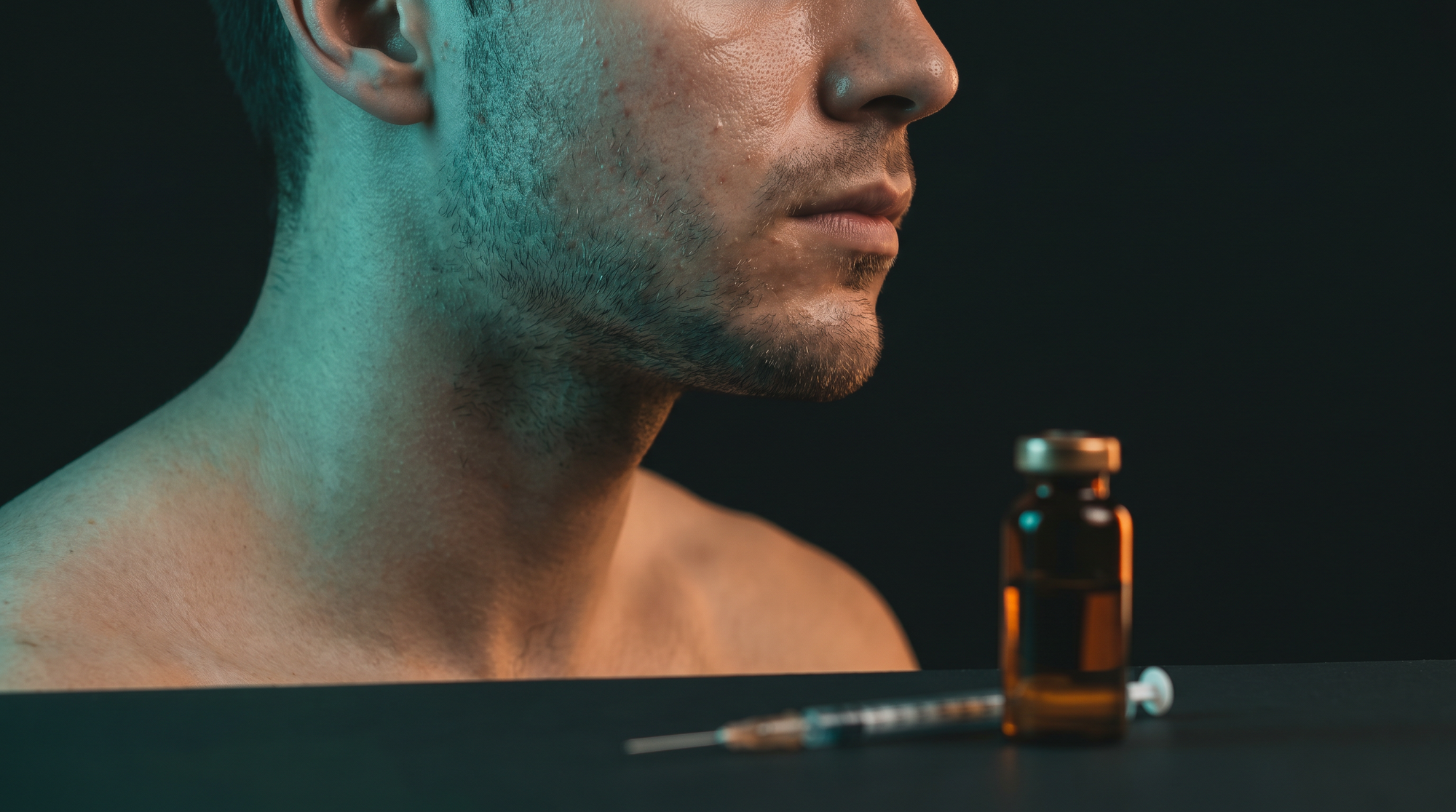
Yes, TRT can cause acne — most often in the first 8–12 weeks, and for most men it's manageable rather than permanent. The driver isn't testosterone alone. It's testosterone converting to DHT in your skin's oil glands, plus the hormone swings of an unsettled protocol, that push your pores to overproduce oil and break out.
That's the honest version of an answer most of the internet skips. The top results on this topic say "yes, wash your face, see a dermatologist" and stop there. This guide explains why it happens, what it looks like, how long it lasts, and the specific protocol and skincare levers that actually clear it — so a breakout becomes a signal you can read, not a mystery you tolerate.
Does TRT cause acne?
For some men, yes — testosterone therapy can trigger acne, and it's one of the more common visible side effects early on. It isn't universal: plenty of men never break out at all. When it does happen, it usually shows up in the first couple of months, concentrates on the back, shoulders, chest, and jawline, and settles as your levels stabilize.
Acne is well-recognized enough to sit on the standard list of testosterone side effects — it belongs in the same bucket as changes to hematocrit, estrogen, and mood that show up across TRT. The mechanism is straightforward dermatology: androgens stimulate the skin's oil glands, and more androgen activity means more oil. Anabolic-steroid users at supraphysiologic doses develop acne at high rates, which is the same pathway running at a much louder volume than a properly dosed TRT protocol (Melnik, Jansen & Grabbe, "Abuse of anabolic-androgenic steroids and bodybuilding acne," JDDG, 2007).
The practical takeaway: a breakout in your first few months is common, expected, and usually temporary. Persistent or worsening acne months in is not "just TRT" — it's a sign one of the mechanisms below is running hotter than it should and is worth adjusting.
Why it happens to some men and not others
Two men on identical doses can have completely different skin. The difference comes down to how much testosterone each one converts to DHT in the skin, how reactive their oil glands are, how much their estradiol swings early on, and whether their dose and injection schedule keep levels steady or send them spiking. Those are the variables we'll unpack — and most of them are ones you can change.
Why does TRT cause acne? The real mechanisms
TRT triggers acne through three stacking mechanisms: testosterone converting to DHT inside your oil glands and driving up sebum, estrogen and hormone swings in the unsettled early weeks, and a dose or injection schedule that amplifies both. Acne happens when extra oil, dead skin cells, and bacteria clog a pore. TRT mainly turns up the oil.
Here's the trigger map most clinic pages never draw:
| Trigger | Why it causes acne | What you can do about it |
|---|---|---|
| DHT → sebum | Testosterone converts to DHT in the skin; DHT supercharges the sebaceous (oil) glands | Stable levels, skincare/retinoids; DHT is the hard-to-change driver |
| Estradiol / hormone swings | Unstable hormones early on inflame and destabilize skin | Manage estradiol, give levels time to settle |
| Dose & injection frequency | Big peaks and troughs mean bigger hormonal swings | More frequent, smaller injections smooth the curve |
Mechanism 1: DHT and your oil glands
This is the main event. Inside your skin, an enzyme called 5-alpha-reductase converts testosterone into dihydrotestosterone (DHT) — a more potent androgen. Your sebaceous glands are loaded with androgen receptors, and DHT binds them hard, telling the glands to produce more sebum (oil). More oil plus dead skin cells plus Cutibacterium acnes bacteria equals a clogged, inflamed pore (Makrantonaki, Ganceviciene & Zouboulis, "An update on the role of the sebaceous gland in the pathogenesis of acne," Dermato-Endocrinology, 2011).
If that DHT pathway sounds familiar, it should. It's the same hormone that drives TRT-related hair loss by miniaturizing scalp follicles. DHT on your scalp thins hair; DHT in your oil glands thickens sebum. One molecule, two side effects — which is why men prone to one are often prone to the other.
Mechanism 2: Estrogen and early hormone swings
When you start or change a protocol, your hormones don't snap to a clean line — they swing while your body recalibrates. Testosterone aromatizes into estradiol, and in those early weeks the ratio between the two can bounce around. Unstable, fluctuating hormones tend to flare skin more than steady high levels do. This is why a breakout often coincides with the first weeks of a new dose. If you're also fighting water retention, moodiness, or nipple sensitivity, your estradiol may be running high — managing estrogen on TRT often calms the skin alongside the other symptoms.
Mechanism 3: Dose and injection frequency
The bigger your hormonal peaks and troughs, the bigger the swing your skin has to absorb. A large dose injected once a week sends testosterone (and the DHT and estradiol that follow it) up to a sharp peak, then down to a trough — a rollercoaster your oil glands feel. Smaller, more frequent injections flatten that curve. Dose size and frequency are two of the most controllable acne levers you have, and we'll come back to them.
Did You Know? Your sebaceous glands carry their own 5-alpha-reductase enzyme, so they can manufacture DHT locally from testosterone — right there in the skin. That's why acne tracks androgen activity even when your blood testosterone looks perfectly in range.
What does testosterone acne look like?
Testosterone-related acne usually shows up as oily skin with inflamed papules, pustules, and deeper cystic bumps — and it favors the back, shoulders, chest, and jawline more than the rest of the face. "Bacne" (back acne) and shoulder breakouts are the classic TRT pattern, because those areas are dense with oil glands that respond strongly to androgens.
A few features that distinguish it from the acne you may remember from your teens:
- Location: Hormonal/androgen-driven acne concentrates on the trunk — upper back, shoulders, chest — plus the lower face and jaw. Pure forehead acne is less typical of the TRT pattern.
- Depth: Androgen-driven breakouts skew toward deeper, tender, cystic bumps rather than just surface whiteheads.
- Oiliness: Noticeably oilier skin and a greasier scalp often arrive at the same time — both are sebum-gland responses.
- Timing: It tends to appear or worsen right after starting TRT or bumping your dose, which is the tell that it's hormone-driven rather than random.
If your breakouts are scarring, spreading fast, or covering large areas of your back and chest, that's beyond a routine adjustment period — loop in a dermatologist early, because deep cystic acne can scar permanently if it's left to run.
How long does acne last on TRT?
For most men, TRT acne flares in the first 8–12 weeks and then eases as hormone levels stabilize and the early swings settle. The breakout tends to track the adjustment window: it's worst while your body is recalibrating to a new dose, and it calms once levels hold steady. Think of it as a transition symptom, not a permanent feature.
That timeline assumes your protocol settles. If you're three or four months in and your skin is the same or worse, time alone probably won't fix it — something is keeping the trigger active. The usual culprits are a dose that's higher than you need, an injection schedule with big peaks and troughs, or estradiol that's running unmanaged. The fix in that case isn't more patience; it's revisiting the protocol (next section) and, if needed, treating the skin directly.
A smaller subset of men — usually those with a personal history of acne or particularly androgen-sensitive skin — may keep some level of breakout for as long as they're on therapy. Even then it's typically controllable with stable levels and a real skincare routine rather than something you have to simply accept.
Who's most likely to break out on TRT?
You're more likely to get TRT acne if you broke out easily before, if your skin is androgen-sensitive, or if your protocol creates big hormonal swings. Genetics and oil-gland reactivity set your baseline risk; your protocol decides how hard that risk gets pushed. The men who break out most tend to stack several of these factors.
Higher-risk profile:
- A history of acne — teenage or adult breakouts predict TRT breakouts, because your oil glands are already androgen-reactive.
- Higher doses — more testosterone means more substrate for DHT and estradiol, so more skin signaling.
- Peak-heavy, infrequent injections — one large weekly shot creates a sharp peak that hits skin harder than split dosing.
- Unmanaged estradiol — letting estrogen swing freely in the early weeks adds a second trigger on top of DHT.
- Oily skin and scalp at baseline — already-busy oil glands have less headroom before pores clog.
None of these are dealbreakers. They're a map of which levers will matter most for you — a man with acne-prone skin on a once-weekly high dose has more room to improve by splitting his shots than someone who never breaks out regardless.
How to prevent and clear acne on TRT — what actually works
The most effective approach combines two fronts: smooth out the hormonal swings driving the oil, and treat the skin directly. Clinic pages stop at "wash your face." The real playbook connects your protocol to your pores — because for TRT acne, the protocol levers often matter more than the face wash.
On the protocol side:
- Stabilize your levels with injection frequency. Splitting your weekly dose into smaller, more frequent shots flattens the peaks and troughs that flare skin. Moving from once-weekly to twice-weekly — or further, to microdosing TRT with smaller daily-to-every-other-day injections — is one of the most reported real-world fixes for breakouts. The total dose stays the same; the curve just gets smoother. (See also why your injection schedule matters for the timing logic.)
- Get your estradiol in range. If high-estrogen symptoms are showing up alongside the acne, managing estradiol with your provider often quiets the skin too. The goal is an in-range, stable level — not crushing estrogen, which causes its own problems.
- Reassess the dose. If you're acne-prone and your numbers are comfortably in range, you may not need to sit at the top of it. A modest dose reduction can lower the androgen and DHT load your skin sees. This is a conversation with your prescriber, not a solo adjustment.
On the skincare side:
- Build a simple, consistent routine. A gentle cleanser twice daily, plus an over-the-counter active like benzoyl peroxide or salicylic acid, addresses the bacteria and clogged pores that the extra oil creates. For body acne, a benzoyl peroxide wash on the back and shoulders is a workhorse. The American Academy of Dermatology's guidance on managing acne is a solid, non-commercial starting point (American Academy of Dermatology, "Acne: Diagnosis and treatment").
- Escalate to a dermatologist when it's warranted. Topical or oral retinoids and prescription treatments are the move for stubborn or cystic acne. A retinoid normalizes how skin cells shed and is one of dermatology's most effective acne tools — but it's a prescription decision, so see a derm rather than guessing.
The order matters: tune the protocol so you're not constantly fighting an uphill oil problem, then let skincare do its job on what's left.
When acne means "adjust the protocol," not just the skincare
Most TRT acne is a passing adjustment-period symptom. But certain patterns are a signal to revisit the protocol with your provider rather than just reaching for another face wash. Treat acne as one data point in a bigger picture — especially when it clusters with other side effects.
Re-check the protocol when you see:
- Acne that's worsening past the 12-week mark, not settling — the adjustment window should be trending the other way by now.
- Breakouts that spiked right after a dose increase — a clear dose-response link points at the protocol, not your skincare.
- Acne plus other high-estrogen or high-androgen symptoms — water retention, moodiness, oily scalp, or accelerated hair shedding alongside the acne suggests a hormone balance issue worth addressing as a whole.
- Deep, cystic, or scarring acne — this needs dermatology input promptly, and may justify a protocol review in parallel.
The reframe is simple: if your skin is breaking out, your protocol might be telling you something. Reading that signal — instead of only treating the surface — is what separates men who clear up in a couple of months from men who fight it for a year.
How Himcules helps you connect breakouts to your protocol
Here's the catch with everything above: acne onset and clearing track the exact variables you're already adjusting — dose, injection frequency, estradiol, and time since your last change. But those connections are nearly impossible to see from memory. Did the breakout start after you bumped your dose, or two weeks before? Did splitting your shots actually help, or did it just feel that way? Without a record, you're guessing.
That's where tracking earns its place. Himcules lets you log a side effect like acne right alongside the protocol that might be driving it — so when you change your injection frequency or your dose, you can look back and see whether your skin followed. You log the shot, log the symptom, and the timeline does the correlating for you. Your data stays on your device, which matters for something this personal.
You can download Himcules free on iOS to track your breakouts against your dose, injection frequency, and time-since-change — and finally see which protocol lever actually clears your skin.
Key Takeaways
Q: Does TRT cause acne? A: It can. Acne is a common early TRT side effect, mainly because testosterone converts to DHT in the skin and drives oil production. It's not universal, and for most men it's temporary and manageable.
Q: How long does acne last on TRT? A: For most men it flares in the first 8–12 weeks and eases as hormone levels stabilize. If it's still going strong after three to four months, the protocol or estradiol usually needs adjusting.
Q: What does testosterone acne look like? A: Oily skin with inflamed and sometimes cystic bumps, concentrated on the back, shoulders, chest, and jawline. "Bacne" and shoulder breakouts are the classic TRT pattern.
Q: Does TRT cause back acne? A: Yes — the back, shoulders, and chest are dense with androgen-sensitive oil glands, so they're the most common sites for TRT breakouts, often more than the face.
Q: Will TRT acne go away on its own? A: Often, yes — as your levels stabilize over the first couple of months. A simple skincare routine speeds it up. Acne that persists or worsens past 12 weeks usually needs a protocol or treatment change.
Q: Does lowering my dose help acne? A: It can, if you're acne-prone and your levels are already in range. A smaller dose reduces the androgen load your skin sees. Discuss any dose change with your prescriber rather than adjusting alone.
Q: Can changing my injection schedule reduce breakouts? A: Frequently. Splitting one weekly dose into smaller, more frequent injections smooths the hormonal peaks and troughs that flare skin — one of the most reported real-world fixes for TRT acne.
This article is for informational purposes only and is not medical advice. Always consult your healthcare provider about your TRT protocol.
Sources
- Melnik B, Jansen T, Grabbe S. "Abuse of anabolic-androgenic steroids and bodybuilding acne: an underestimated health problem." Journal der Deutschen Dermatologischen Gesellschaft, 2007
- Makrantonaki E, Ganceviciene R, Zouboulis C. "An update on the role of the sebaceous gland in the pathogenesis of acne." Dermato-Endocrinology, 2011
- American Academy of Dermatology. "Acne: Diagnosis and treatment."